
What is an Indirect Source Rule?
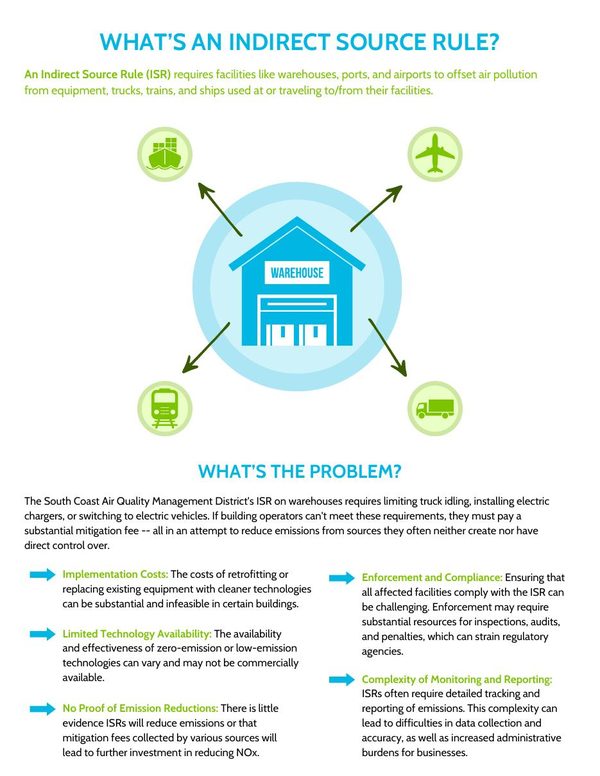
An Indirect Source Rule is a regulation imposed on businesses that generate traffic from trucks, vehicles, and other transportation sources. These rules often target warehouses, distribution centers, ports, and logistics hubs. They do not regulate emissions directly; instead they impose fees and operational restrictions based on vehicle traffic or facility size.
ISRs are being promoted in multiple regions under the premise of reducing emissions from the supply chain. Supply Chain Federation's position is that they may increase emissions while simultaneously driving up costs for businesses, workers, and consumers.
Why do ISRs lead to higher, not lower, emissions?
Despite their stated goal of improving air quality, ISRs fail to account for how supply chains function. These rules create inefficiencies, increase truck miles, and ultimately raise emissions.
- Longer truck routes and higher emissions. ISRs discourage companies from operating in key logistics hubs, forcing them to relocate warehouses and distribution centers farther from consumers and major transportation corridors. Trucks must then travel longer distances, increasing fuel consumption, congestion, and pollution.
- Supply chain disruptions and inefficiencies. Instead of reducing truck trips, ISRs force companies to reroute shipments in ways that lead to more frequent and fragmented deliveries — more trucks on the road, more fuel burned, more emissions generated.
- Shifting jobs and emissions to less regulated areas. ISRs do not eliminate emissions; they push businesses and jobs to different locations, often outside the regulated area. That does nothing to reduce pollution regionally — it moves the emissions elsewhere.
How do ISRs affect local businesses, workers, and consumers?
- Job losses in key logistics hubs. Warehouses and distribution centers provide thousands of working-class jobs. ISRs make it more expensive to operate in key regions, driving local businesses away and taking jobs with them.
- Higher costs for goods and services. Increased regulatory fees and inefficiencies raise the cost of transportation, which directly affects the price of goods consumers buy every day.
- Strain on local economies. Small companies, suppliers, and logistics providers bear the brunt of these costs, making it harder for them to stay competitive.
What are the alternatives?
Rather than punitive regulations that may not achieve the intended environmental results — and that fall hardest on the workers and communities who can least afford it — the Federation supports collaborative solutions that improve both environmental and economic outcomes.
- Invest in modern infrastructure. Expanding and upgrading ports, highways, and rail networks to reduce congestion and improve fuel efficiency.
- Support cleaner technologies. Tax incentives, grants, and financing to help logistics companies transition to cleaner vehicles, equipment, and energy sources.
- Encourage industry-led innovation. Working with supply chain leaders to develop sustainable logistics solutions rather than imposing costly and ineffective mandates.
Why was the ISR created?
The South Coast Air Quality Management District pushed the ISR as a workaround because it lacks jurisdiction over trucks, trains, ships, and other mobile sources. Instead it targeted warehouses and logistics hubs, which it can regulate, to indirectly influence truck traffic. Supply Chain Federation's view is that this backdoor approach does little to cut emissions and instead raises costs and disrupts supply chains — and that other states and cities are now considering the same model even though they have direct authority to regulate trucks themselves.
Supply Chain Federation's position
The Supply Chain Federation advocates for policies that reduce emissions without harming businesses, workers, and consumers. Indirect Source Rules do not solve the problem — they create new ones. Policymakers should reject ISRs in favor of common-sense solutions that balance environmental progress with economic sustainability.